前程无忧
New Discoveries in Pompeii Showcase the City’s Middle Class_我的网站

A |
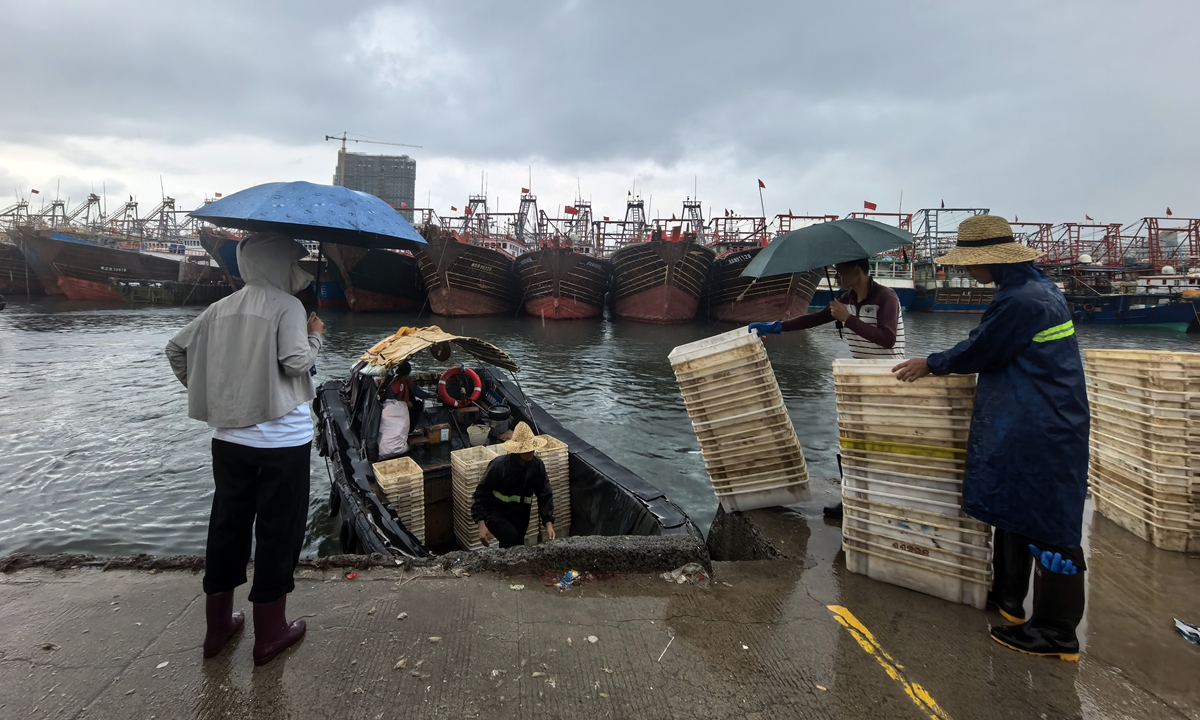
Fishermen in South China’s Guangxi Zhuang Autonomous Region return to port to shelter from the typhoon on August 21, 2026. Photo: VCG
China Meteorological Administration (CMA) issued a Level IV emergency response for typhoon and heavy rain on Saturday, when typhoons including Gaenari, Narra, and Saudel created a rare situation in which three typhoons were active simultaneously over the South China Sea and the Northwest Pacific.
As Typhoon Gaenari, the 20th typhoon of this year, formed on Saturday afternoon, a total of 20 typhoons have formed since January this year, well above the historical average of 13.4 typhoons form from January to August, despite August is not yet over. Statistics also show that typhoons have formed every month from January through August this year, with the number of typhoons generated each month exceeding the average for the same period in previous years, Beijing Daily reported.
Typhoon Gaenari was about 320 kilometers east-northeast of Taipei on China’s Taiwan, as of 2 pm on Saturday, packing maximum winds of 18 meters per second near its center.
Typhoon Gaenari is expected to move rapidly northwestward at a speed of 35 to 40 kilometers per hour, with little change in intensity, China Central Television reported on Saturday.
While the combined influence of Typhoon Narra, the 19th typhoon of this year,and the southwest monsoon is set to bring heavy rain to parts of South China and coastal areas of East China’s Zhejiang and Fujian provinces over the next three days, Typhoon Saudel, this year’s 18th typhoon, is forecast to move northwest and strengthen.
China’s National Meteorological Center maintained a blue typhoon warning on Saturday morning, with Typhoon Narra centered over the Beibu Gulf, about 30 kilometers south of Dongxing city, South China’s Guangxi, China Central Television (CCTV) reported.
Typhoon Narra is forecast to linger over the Beibu Gulf from Saturday afternoon to Sunday night, strengthening to a severe tropical storm before slowly moving northeastward and northward from Monday. It is expected to weaken as it approaches the Leizhou Peninsula in Guangdong and coastal areas of southern Guangxi.
Typhoon Narra and the southwest monsoon are expected to bring heavy to torrential rain to Hainan, southern Guangxi and coastal Guangdong over the next three days, with some areas facing extreme rainfall.
China’s National Flood Control and Drought Relief Headquarters and the Ministry of Emergency Management activated a Level IV emergency response for flood and typhoon control in Hainan, Guangxi and Guangdong at 8 pm on Friday.
Meteorological experts warned that Typhoon Narra will follow a complex track and linger over the Beibu Gulf, urging heightened precautions for maritime activities, transportation and coastal tourism. Heavy rain could trigger mudslides, landslides and flooding, while localized severe weather may also cause secondary disasters, chinanews.com reported.
In addition, Sun Qianqian, a meteorological analyst with the CMA, said that sea surface temperatures along Typhoon Saudel’s path are relatively high, and the storm is expected to intensify rapidly in the coming days, potentially reaching super typhoon strength. Around Wednesday, it is expected to pass through the Ryukyu Islands and move into the East China Sea, after which its track remains somewhat uncertain.
According to Sun, an active South China Sea monsoon and multiple interacting tropical systems are expected to bring heavy rain to coastal areas from southern to eastern China through Monday. Southern Guangxi, Hainan, southern Taiwan Island, eastern Guangdong, southern Fujian and southern Shandong are likely to see the heavy rainfall, with risks of rain-related secondary disasters, CCTV reported.
Global Times
。 Recent discoveries in Pompeii are revealing the lifestyle of the middle class in the ancient Roman city. Pompeii’s archaeological park announced its findings on Saturday. While much of the early studies of Pompeii were focused on the city’s elite, archeologists have increasingly become interested in the lives of the city’s middle and lower classes.,The excavation of a home or “domus” started in 2018 and is now paying dividends. The house had a courtyard with a well-adorned cistern or water tank, but other parts of the house show that the owner may not have had unlimited funds to decorate their house. One of the five rooms was left unpainted and with an earthen floor. Archeologists believe it may have been used for storage.,They also identified a bedroom with the remains of a bedframe and cloth from a pillow. The bedframe appeared identical to three cots found in a storage room that may have also served as sleeping quarters for enslaved people in the city.,Science & TechVideos: Archeologists Discover IKEA-Like Adjustable Beds in Ancient Roman City of Pompeii8 November 2021, 02:29 GMT,Another storeroom had built-in shelves and may have held dishes and cookware for a nearby kitchen. Archaeologists also discovered a storage trunk. While the trunk itself was damaged when the ceiling collapsed on it, they found a preserved oil lamp with carvings of the Greek god Zeus, called Iupiter by the Romans, transforming into an eagle.,"In the Roman empire, there was an ample chunk of the population that struggled with their social status and for whom 'daily bread,' was anything but a given,'' Gabriel Zuchtriegel, Pompeii’s archaeological park’s director said. "A vulnerable class during political crises and food shortages, but also ambitious about climbing the social ladder.",Archaeologists also found a fragment of what they believe was a translucent plate rimmed with emerald and cobalt blue and an intact incense burner shaped like a cradle.。

B |
Current article:http://s8q2ytw.wenwancaomohenenqiongpangshun.bond/yuli/fidi.html
Published on:00:00:00